Find the critical decisions
AI agents map the decisions a role carries and identify where expertise exists only in one person's head.
Organizations in workforce transition
Organizational Intelligence Continuity Assurance is a product we are building to test whether the knowledge behind critical decisions has been captured, validated and handed over — before a role change, restructure or AI-driven redesign is accepted as complete.
The challenge
As organizations adopt AI and restructure teams, they risk losing what was never written down: the exceptions, the history and the reasoning behind important decisions. A departing expert takes that judgment with them, and nobody notices until a successor gets a consequential call wrong.
Handover documents, HR systems, document search and exit interviews each capture part of the picture. None of them test whether a successor can actually reconstruct and make the decisions the role depends on.
The approach
AI agents map the decisions a role carries and identify where expertise exists only in one person's head.
Structured, adaptive interviews record not just what was decided, but why — and which exceptions applied.
Every captured insight is tied to its source records, so knowledge is grounded rather than remembered.
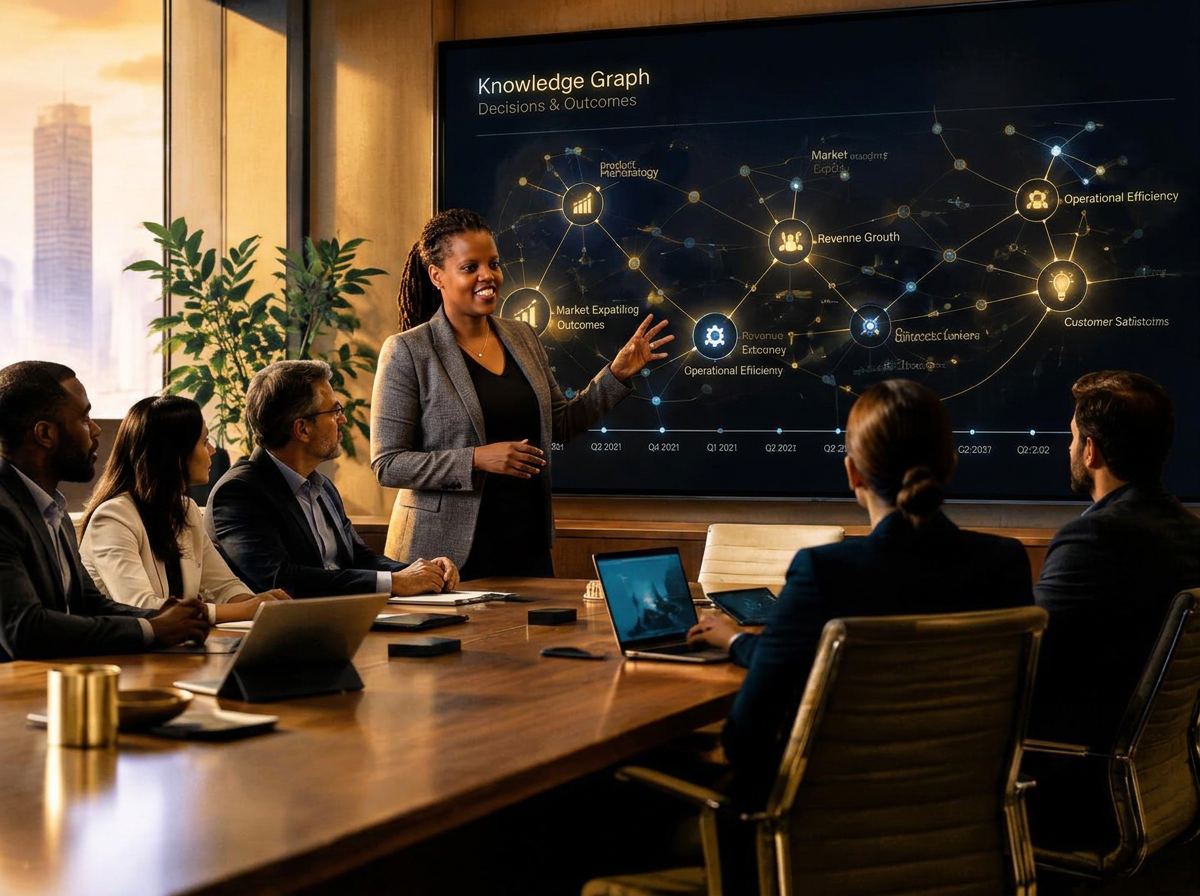
A temporal knowledge graph stores decisions, roles, policies and evidence as they were valid at a given moment, so past context can be reconstructed accurately.
Successors work through realistic decision scenarios, including held-out cases, rated by independent experts.
Approved knowledge and attestations are bound to named reviewers with verifiable credentials — creating an auditable continuity gate before the transition closes.
Why existing approaches fall short — and what OICA adds
| Common approach | Where it falls short | OICA difference |
|---|---|---|
| Handover documents | Record tasks, rarely the reasoning or exceptions | Evidence-linked capture of decision rationale |
| HR systems | Track the role, not the judgment it requires | Map of critical decisions per role |
| Search & AI assistants | Retrieve documents without time or context | Time-aware reconstruction of past decisions |
| Exit interviews | One-off conversations with no verification | Successor scenario testing and accountable sign-off |
Governance built in
Where it stands
"AI capability alone does not guarantee institutional continuity."Book a strategy call
Next case study
Quantum Legal