Evidence before assurance
No check is ticked without a Clio location. Every completed step must be evidenced in the system of record.
Quantum Legal
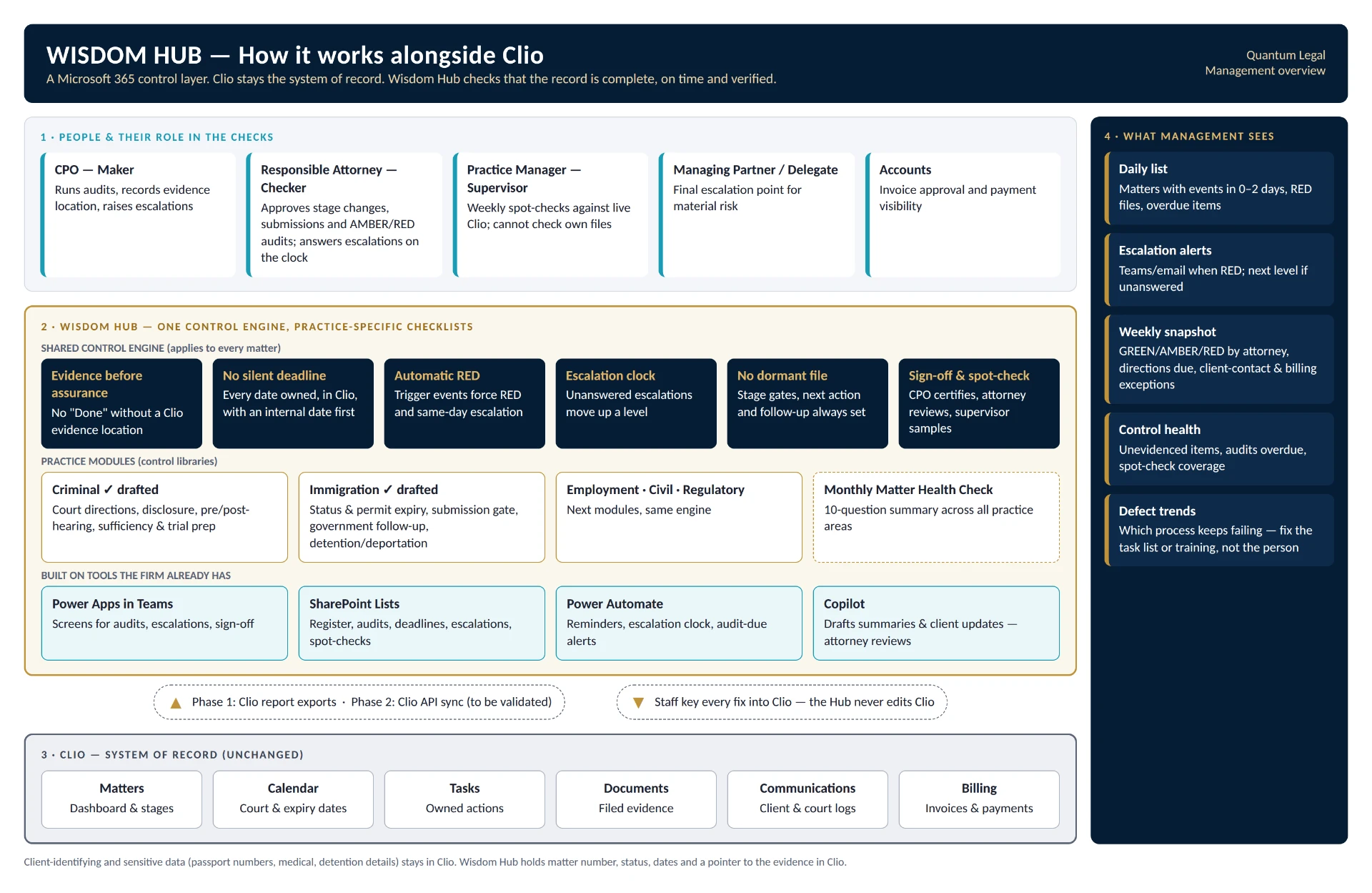
Clio is where the firm's work is recorded. Wisdom Hub is how the firm knows that record is complete, on time and checked — built with the Microsoft 365 tools it already pays for.

The challenge
The firm's difficulty was never legal skill. It was that no one could see, at a glance, which matters were on track. Missed deadlines, clients left without updates and fees never collected were costing revenue and client confidence.
Because the Clio record was often incomplete, it could not tell the truth about a file — so reviews relied on verbal assurance rather than evidence.
The approach
No check is ticked without a Clio location. Every completed step must be evidenced in the system of record.
Every court direction becomes an owned Clio task with an internal date. Overdue means RED.
The same six rules apply to every matter; only the checklist, key dates and red flags change by practice area.
Case officers audit, attorneys approve, the practice manager spot-checks against live Clio — and self-checking is blocked.
A three-level escalation ladder puts a timer on the person escalated to, not just the person escalating.
Partners see risk status, control health and recurring defects across every active file.
In detail
Wisdom Hub is a Microsoft 365 control layer — not another system of record. Clio keeps the file: matters, calendar, tasks, documents, communications and billing. The Hub sits above it with one control engine and practice-specific checklists, built entirely on tools the firm already pays for — Power Apps in Teams, SharePoint Lists, Power Automate and Copilot. Every person has a defined role in the checks, from the case officer who records evidence to the managing partner as the final escalation point, and management sees a daily risk list, escalation alerts and control health at a glance. Sensitive client data never leaves Clio — the Hub holds only matter numbers, status, dates and a pointer to the evidence.
From a review of seven matters listed for a single court day
| What we saw | Why it happened | Wisdom Hub control |
|---|---|---|
| Clients told of a court date weeks earlier, no reminder since (6 of 7) | No defined reminder cadence | Cadence checked at every audit; missing = AMBER |
| Court directions overdue by up to ten weeks | Directions not converted into owned tasks | Every direction owned; overdue = RED |
| A hearing with no holding attorney assigned | Attendance not confirmed in advance | Pre-hearing readiness gate |
| Immigration files waiting for months | Government silence treated as inactivity | Dormancy test with follow-up and client update dates |
In detail
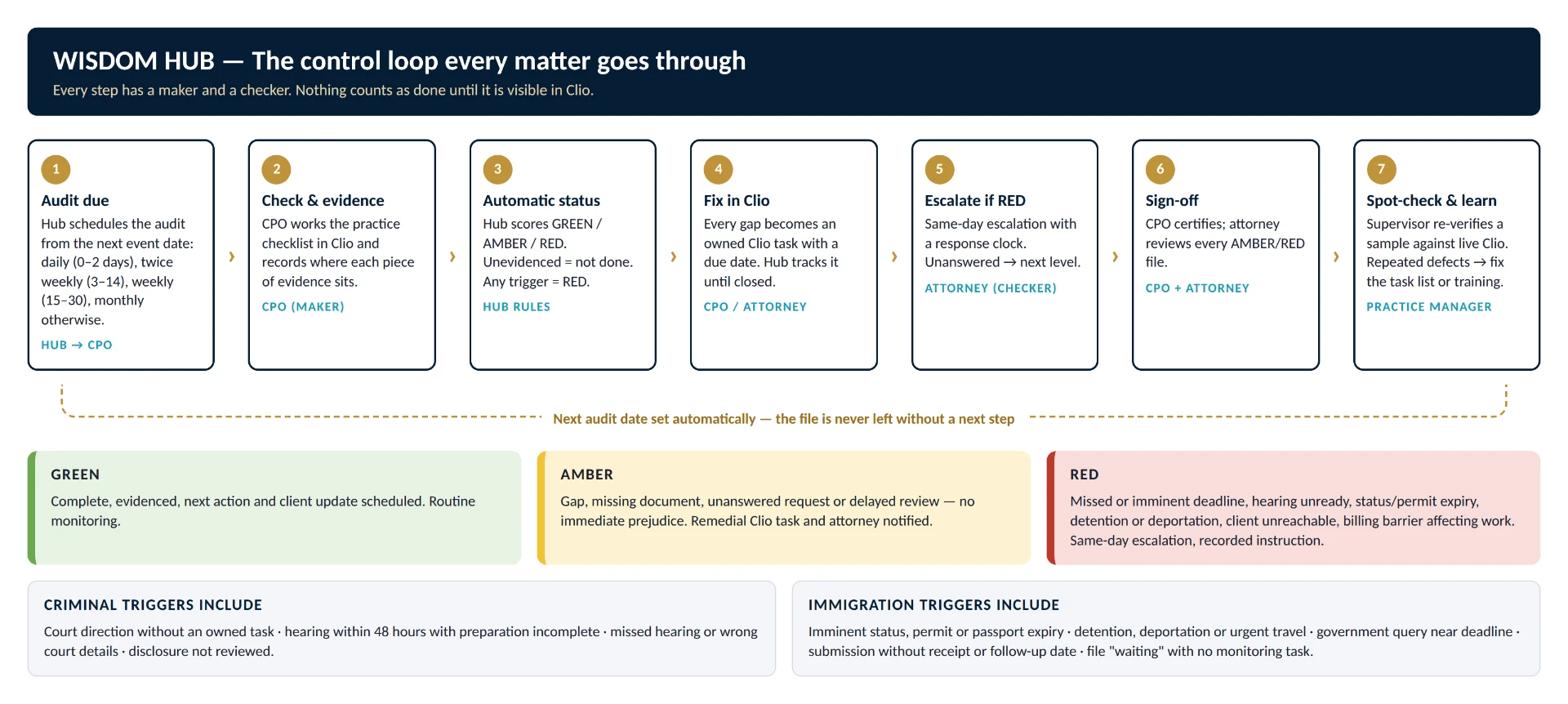
Every step has a maker and a checker, and nothing counts as done until it is visible in Clio. The Hub schedules each audit from the next event date, the practice office works the checklist and records where the evidence sits, and Hub rules score the file GREEN, AMBER or RED. Every gap becomes an owned Clio task with a due date, unmet RED items escalate same-day up a response clock, the attorney reviews every AMBER and RED file, and a supervisor re-verifies a sample against live Clio. The next audit date is then set automatically — a file is never left without a next step. Triggers include court directions without an owned task, a hearing within 48 hours with preparation incomplete, imminent status or permit expiry, and files marked "waiting" with no monitoring task.
Governance built in
Where it stands
"The problem was never legal skill. It was visibility."Book a strategy call
Next case study
International Planned Parenthood Federation