
Standardise the core
Turn recurring induction topics — company context, conduct, client service, data protection, benefits and support — into one consistent sequence for every employee.
Quantum AI R&D
A role-based induction experience that helps small and midsize businesses onboard every employee to the same standard, without using their team's time to repeatedly deliver the training.

The challenge
Employee onboarding is often delivered differently depending on who is available, how busy the team is and what the new hire remembers to ask. Managers repeat the same introductions, policies and process explanations, while important role-specific details can still be missed.
Large corporations have long used learning platforms to standardise induction and prove completion, but the cost and effort of building them kept that capability out of reach for many smaller companies. Today, an SMB can provide the same structured experience at an investment below the cost of an intern salary.
The approach
Turn recurring induction topics — company context, conduct, client service, data protection, benefits and support — into one consistent sequence for every employee.
Add role-specific sections for responsibilities, systems, workflows and first-week expectations, so each employee sees what is relevant without losing the common foundation.
Give new hires a clear dashboard they can work through at their own pace, with visible progress, completed sections and the next action always easy to find.
Use a policy assessment to check comprehension rather than relying on a tick-box acknowledgement that the material was opened.
Record progress and assessment results, then issue a dated certificate when the induction and required test have been completed.
Move repeatable knowledge into the product so managers can focus their live time on relationships, judgement, context and questions that genuinely need a person.
In detail
The employee sees a clear sequence of company-wide and role-specific sections, what is complete and what remains. Core topics such as conduct, client service, data protection and information security sit alongside tailored technology, workflow and responsibility modules. Progress is visible without a manager having to chase updates or repeatedly explain where the employee should go next.
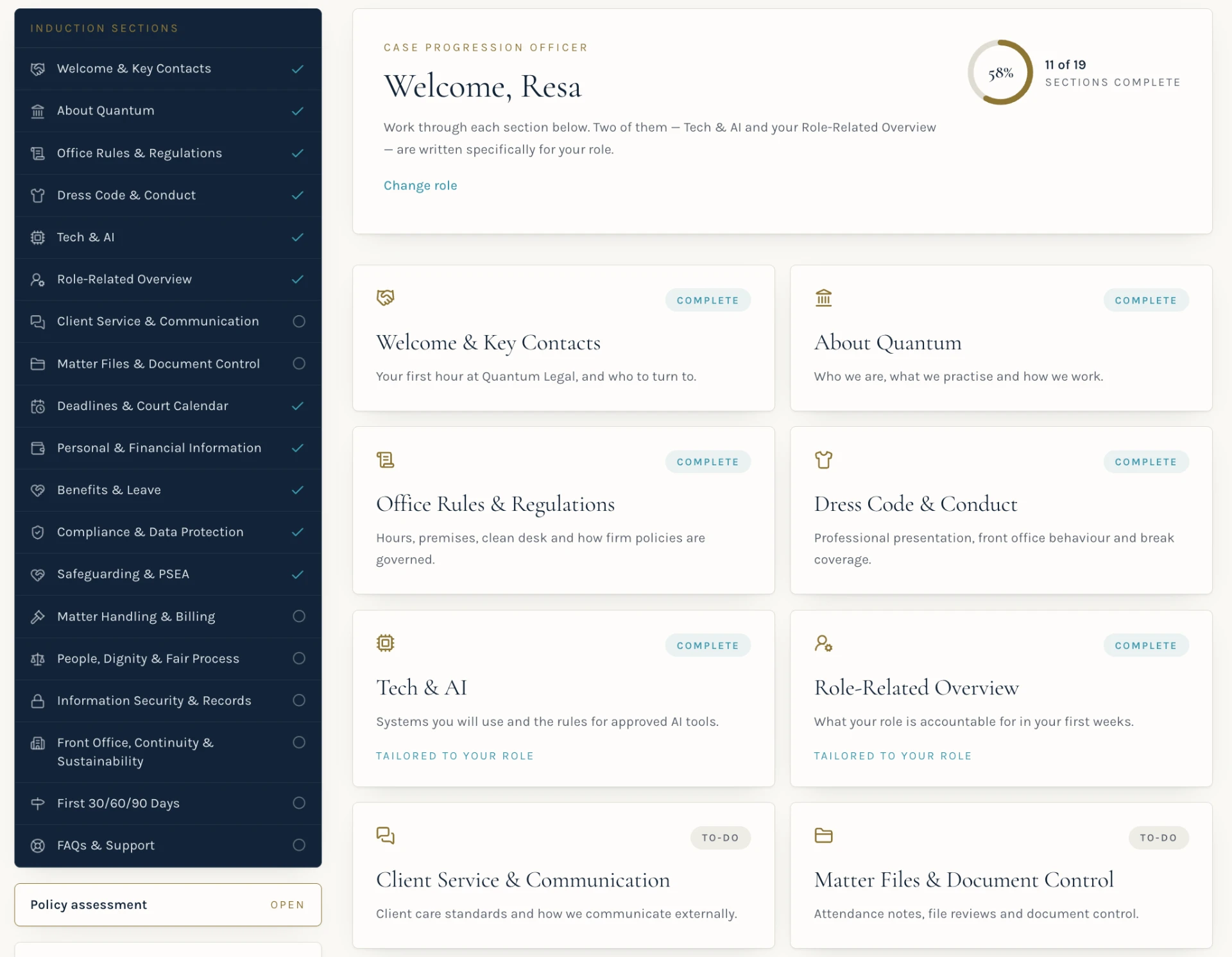
From repeated delivery to measurable onboarding
| Onboarding need | How the product handles it | Employer benefit |
|---|---|---|
| Company-wide induction | A shared sequence of approved information and policies | Every employee receives the same foundation |
| Role readiness | Role-specific modules, systems and first 30/60/90-day guidance | Relevant learning without rebuilding each induction |
| Progress visibility | Section-level status and overall completion tracking | Managers know what has and has not been reviewed |
| Policy understanding | Assessment with a recorded result and completion certificate | Evidence that the employee completed and understood the required material |
In detail
A policy assessment checks whether the employee understood the required material. When the induction and test are complete, the system creates a dated record and certificate showing the role, result and issuing organization. Employers gain evidence of completion, while the employee receives a clear milestone marking readiness to move forward.
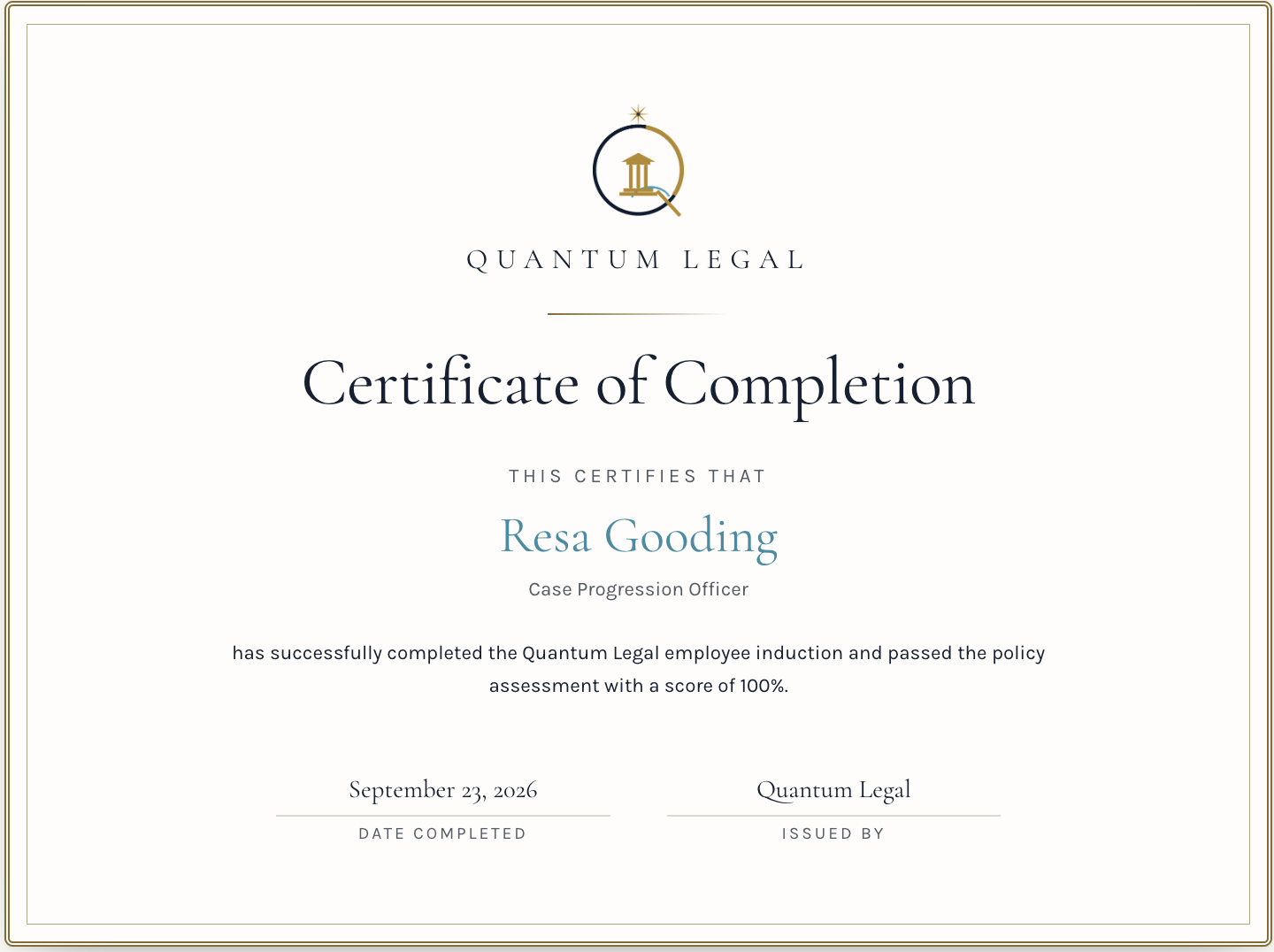
Governance built in
Where it stands
"The first employee and the fiftieth should receive the same clear standard."Book a strategy call
Next case study
Organizations in workforce transition